
Key to Unlock Your Productivity Potential Using PowerApps

Overview of PowerApps and Its Capabilities

 Organizations need updated tools to quickly react to changing business processes and get the organization running as quickly as possible. To improve existing business processes or set up new ones, custom software development takes time. It must go through several stages before being ready for production.

As a result, organizations want a powerful tool to deploy or change their business processes. Low Code / No Code tools come into play in these situations, allowing developers to pitch in and get the ball going. The market for hassle-free app development platforms is fast growing in the realm of low-code development.

In January 2017, Microsoft launched PowerApps amid the rise of various game changing applications. PowerApps is yet another Microsoft solution connected with the Office 365 package of tools. It provides new potential for businesses of all kinds to build custom apps, automate processes, and achieve efficiency. It is a simple business software for mobile devices and has a drag-and-drop user interface. It allows you to build a mobile app by adding different controls, media, forms, and screens.

There are various platforms with low code / no code features now, but when it comes from Microsoft, which has a variety of products to manage, it is a different story. Power Apps make it easier to create custom applications to solve business problems. It is a simple, quick, and cost-effective approach to transform your amazing ideas into apps. When you combine Power Apps with other Microsoft Power Platform products, you can quickly construct professional-grade apps, automate workflows, connect to a variety of data sources, and incorporate dashboards into your apps.

5 Reasons Why PowerApps So Successful?
1. Simple App Creater

Save time and effort with PowerApps’ drag-and-drop features and pre-built templates, making app development a breeze even for non-coders

2. Efficiency and Speed

PowerApps’ dynamic and visual interface allows developers to collect feedback and input from users and management in real-time, speeding up the app development process

3. Easy Data Connectivity

PowerApps seamlessly integrates with other Microsoft products such as SQL Server, SharePoint, and OneDrive, as well as external data sources like Google Docs, SAP, Oracle, and Dynamics 365, making data management a breeze.

4. Mobile Features Access

Take advantage of PowerApps’ ability to access hardware functionalities on mobile devices, such as cameras and GPS location services, to create apps with advanced features that improve business processes.

5. Low Cost

PowerApps offers an economical alternative for app development, with affordable pricing plans and the added benefit of free access to Office 365 for data storage and usage.

Unlock Your Productivity Potential Today with PowerApps

If your organization is looking to streamline business processes, connect to various data sources, and create user-friendly apps, PowerApps is the ideal solution. Partner with our MeshBA team for expert assistance in unlocking the full productivity potential of PowerApps and driving efficiency in your operations.

How Intranets Can Boost Employee Engagement in the Digital Workplace?

You may have heard about Intranet. It can be your solution to build a more engaged digital workplace. In this article we will give you an in-depth look at how an intranet platform can help you to increase employee engagement.

What is Employee Engagement?

Employee engagement is the connection between an employee and the organization he or she is working for. A positive employee experience has several, extensive advantages. Employees feel like they are important and valued members of an organization. Organizations often compete for the best and most relevant experience in this talent-hungry environment. An organization can genuinely stand out from its competitors by having a positive working culture. 

In a digital workplace changed by Covid-19 pandemic, more and more organizations are recognizing the power of the employee engagement to connect and communicate with a workforce. The idea of employee engagement is having a significant impact on how organizations think about their digital workplace. 

There are no easy short-cuts to solve this problem of employee engagement. Generally, organizations try to implement an employee management system but it will not bring immediate results. It takes time and effort. 

According to Harward Business Review 

  • More than 70% of businesses consider employee engagement as a very important factor to achieve overall organizational success. 
  • 25% of businesses are confident that their employees are highly engaged within the organization.
How Can Intranets Boost Employee Engagement?
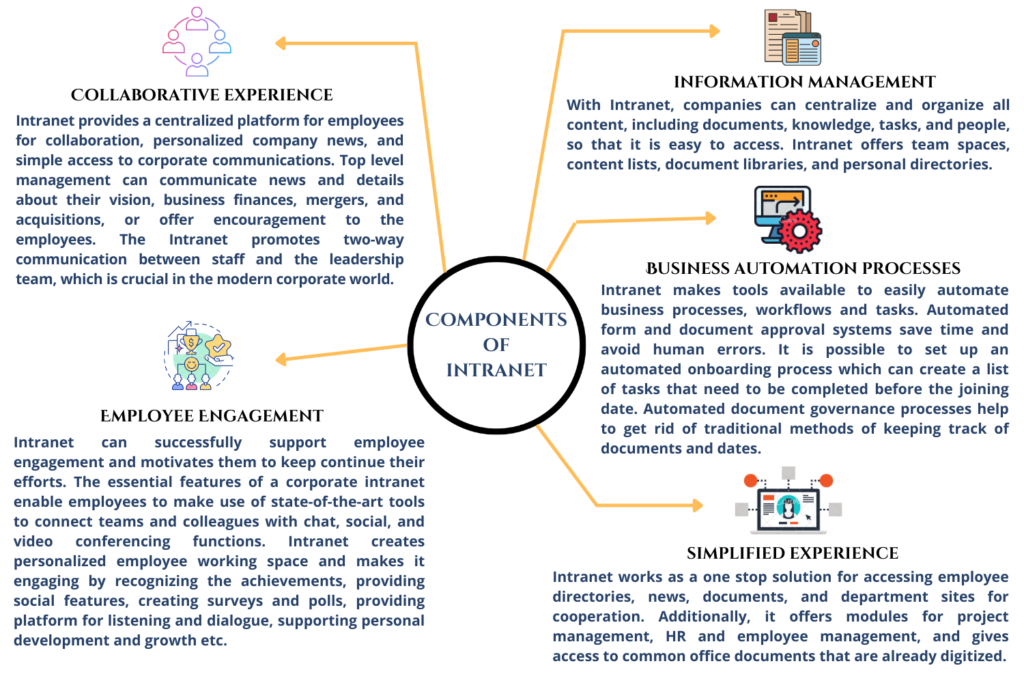
  • It provides opportunities for employees to connect with each other
    According to Talent Tech Outlook 2022 study, remote working has now become the new normal with 82% of employees preferring to work from home. Working from home is becoming a common practice in many industries. Employees may feel less engaged and connected to their company while working from home. This can hurt the productivity and performance of the employees. Using an Intranet creates an environment which provides opportunities for employees to collaborate with each other. It enables employees to connect with their colleagues where they can exchange information through people directory, channels, telecommunication and projects. It improves collaboration and communication, boosts their morale and reinvents the way your organization and employees work.
  • It motivates employees by recognizing their efforts.
    The essential components of intranet for corporations provide the tools to make it more engaging:
    – Create surveys and polls to gauge how the employees adopt the intranet which can guide you with requirements for future upgrades.  – Recognize employees for their achievements, post updates about their birthdays and work anniversaries.  – Provide personalized employee workspaces where users can access bookmarked sites, documents, conversations and people, upcoming tasks and reminders, calendars, etc.  – Have social features like commenting and sharing an article or blog, or having a discussion on matters related to organization. 


  •  It can be integrated with Microsoft 365.  With Microsoft 365, creating a modern intranet can be simple and cost-effective. Microsoft 365 provides a wide range of tools and applications that can enhance your intranet and make it more functional. It provides multiple features along with being in the cloud, having a streamlined user experience across all tools, an excellent track record for up times, and offering multiple security layers. An intranet on Microsoft 365 provides a modern digital workplace solution that will meet the various needs of your employees and will stay for a very long time. 


  • It provides relevant information with customized search and targets. An Intranet on Microsoft 365 uses Microsoft graph API for its search functions. When a user conducts a search, the Microsoft graph can give relevant and personalized information because it tracks content interaction and creates links between individuals, content and activity.  Microsoft 365 users can get quick and relevant search results as they can organize content in libraries and folders, tag them with keywords and save their preferred search criteria. 


  • Its Mobility helps in bridging the location gap

    A modern digital workplace allows employees access to all collaborative tools needed to complete their work. Intranet is an integral part of the digital workplace as it helps to achieve the employees’ expectations of seamless remote working, mobility and easy access to their tools and information. With an Intranet, they can manage and update their tasks, work on their documents, check the status of their projects from any location. 


If you want to increase employee engagement of your organization and would like more information about the company intranet, then Contact Us.

How Can ServiceNow Transforms Facility Management Services?

Understanding ServiceNow Facility Management

ServiceNow Facilities Management is an effective facilities service management solution, which allows users to request changes to the operation and maintenance of their facilities. Facilities staff track these requests through an admin dashboard and make necessary changes across multiple domains such as building facilities, purchasing, marketing, human resources, finance, sales, operations. Facility and space planning requests were typically submitted prior to ServiceNow facility management and addressed via email and phone, with little transparency throughout the process.  

With ServiceNow Facilities Management, users and administrators can access facility information and services on desktop and mobile devices using a self-service portal. The integration of chatbots or voice assistants with ServiceNow platform enables facility teams to resolve issues any time at a faster resolution speed. 

The ServiceNow facility management tool takes care of critical and time-consuming needs and helps employees focus on core business improvements. Also, this tool helps employees solve problems by informing them about available resources. All facility management needs are addressed within the ServiceNow facility management platform without having to manage multiple tools.

How can ServiceNow transform facility management services?
Regulatory compliance

Ensuring regulatory compliance is an important role of facility management. They are responsible for reducing expenditure and making sure the business meets all its goals. If they fail to comply, then it may result in temporary shutdown of business operations which leads to losses.  ServiceNow helps to comply with the policies, regulations, and best practices in one system. You can use it to test against issues of compliance and include the necessary activities according to requirements. After that you can automate repetitive processes. 

Data-based facility management

Many repetitive and basic tasks are handled by facility teams. The alignment of these tasks is not often according to employee specific needs. You need data to align these tasks to employee needs. Data collection can be done using smart technologies like sensors. This data will help to make the right decisions. This integrated system of action is possible with the ServiceNow Connected Operations. 

ServiceNow Predictive Intelligence takes care of workflow automation which auto-creates the tasks via Natural Language processing (NLP) 

New insights to optimize facility services

Traditional facility management relies mainly on procedures that are followed on a regular basis and lacks workload visibility to customize services to individual needs. This is not the case with ServiceNow Facility Management. It provides managers with information about workplace services, workload, requests, assets, and challenges, as well as trends and predictions in these areas. 

Asset tracking and management

To operate the modern facilities at peak efficiency is a challenge. Facility management software is a necessity now to run the facilities optimally. ServiceNow helps to create accurate, comprehensive asset registers. Employees can get all the information about assets (specifications, warranty, maintenance history, performance insights) in a quick time. 

Collaboration & Mobility

With the increasing demands on facilities management, ServiceNow can be especially useful in circumstances when employees offsite need access to crucial business data. Employees can collaborate on projects from anywhere. The only condition is they should have an internet connection and a mobile device. Data can be accessed in a single digital database which rules out the possibility of errors. 

Integrated move management

Managers have a huge responsibility for keeping the record of the changes to the facilities being used. You can easily shift departments into other workspaces or distribute the equipment thanks to the integrated move management tool. 

Do you want to unlock these benefits by adding ServiceNow to your Facilities Management?

5 Questions for Connected Product UX

Whether you are building an enterprise web portal or a state-of-the-art website, you always need the right modern tools. Well-built and maintained PHP frameworks provide those tools in abundance, allowing maintained PHP frameworks provide those tools in abundance, allowing developers to save time, re-use code, and streamline the back end. As software development tools continuously change to follow the latest. Despite the competition from startups and the ever-present economic challenges, the banking industry is gradually adopting what the latest technologies have to offer.

From cloud technology to cyber risk management to machine learning in investment banking, join us as we explore the banking industry trends for 2019 and beyond. Cloud is one of the current banking industry trends as well. It is expected that the technology will serve as a foundation for core modernization of banking organizations.

Cloud Technology as New Foundation

Cloud has become the new normal for nine of ten enterprises across industries. The average IT environment in both SMBs and larger companies is becoming increasingly cloud-based. Companies also diversify their delivery models, with Infrastructure as a Service (IaaS) and Platform as a Service (PaaS) gaining more and more traction. Plus, a slew of new job positions have emerged to manage different aspects of cloud in the enterprise, including architecture and safety.

One of the new trends in the banking industry, ensuring fail-safe security will also be a core question regardless of the type of a cloud solution and its scale. Cloud is one of the current banking industry trends as well. It is expected that the technology will serve as a foundation for core modernization of banking organizations.

Risk Management Banking Industry Trends

Existing risk management systems at banking organizations might not be ready to face the challenges of the rapidly changing world. Poised to become the top banking industry trends for 2019 and years to come, AI-driven solutions with machine and deep learning algorithms provide a solution. As for cyber risk management, experts at Deloitte point at the following trends in the banking industry:

  1. Strengthen basic controls like IT asset, patch, and vulnerability management to identify and manage risks related to implementation of cloud and migration to open architecture.
  2. Use analytics tools and AI with security in mind.
  3. Build an IT infrastructure with security as a top priority: it should be able to withstand systematic attacks and long stress periods.
Risk Management Banking Industry Trends

Fintechs and nonbanks now have a substantial influence in the banking industry. They are highly agile, innovative, and aim at exceeding the demands of modern customers in banking services and experiences. Established retail banks need to compete and often play catch-up. Still, they acknowledge the need to change, and change fast.

There are no secrets to success. It is the result of preparation, hard work, and learning from failure.

– Paul Tournier

Thus, adopting the same approach is a potent solution for retail banks that aim at adopting the latest trends in the banking industry quickly and impactfully.

Augmented Reality Platform By Google

Whether you are building an enterprise web portal or a state-of-the-art website, you always need the right modern tools. Well-built and maintained PHP frameworks provide those tools in abundance, allowing maintained PHP frameworks provide those tools in abundance, allowing developers to save time, re-use code, and streamline the back end. As software development tools continuously change to follow the latest. Despite the competition from startups and the ever-present economic challenges, the banking industry is gradually adopting what the latest technologies have to offer.

From cloud technology to cyber risk management to machine learning in investment banking, join us as we explore the banking industry trends for 2019 and beyond. Cloud is one of the current banking industry trends as well. It is expected that the technology will serve as a foundation for core modernization of banking organizations.

Cloud Technology as New Foundation

Cloud has become the new normal for nine of ten enterprises across industries. The average IT environment in both SMBs and larger companies is becoming increasingly cloud-based. Companies also diversify their delivery models, with Infrastructure as a Service (IaaS) and Platform as a Service (PaaS) gaining more and more traction. Plus, a slew of new job positions have emerged to manage different aspects of cloud in the enterprise, including architecture and safety.

One of the new trends in the banking industry, ensuring fail-safe security will also be a core question regardless of the type of a cloud solution and its scale. Cloud is one of the current banking industry trends as well. It is expected that the technology will serve as a foundation for core modernization of banking organizations.

Risk Management Banking Industry Trends

Existing risk management systems at banking organizations might not be ready to face the challenges of the rapidly changing world. Poised to become the top banking industry trends for 2019 and years to come, AI-driven solutions with machine and deep learning algorithms provide a solution. As for cyber risk management, experts at Deloitte point at the following trends in the banking industry:

  1. Strengthen basic controls like IT asset, patch, and vulnerability management to identify and manage risks related to implementation of cloud and migration to open architecture.
  2. Use analytics tools and AI with security in mind.
  3. Build an IT infrastructure with security as a top priority: it should be able to withstand systematic attacks and long stress periods.
Risk Management Banking Industry Trends

Fintechs and nonbanks now have a substantial influence in the banking industry. They are highly agile, innovative, and aim at exceeding the demands of modern customers in banking services and experiences. Established retail banks need to compete and often play catch-up. Still, they acknowledge the need to change, and change fast.

There are no secrets to success. It is the result of preparation, hard work, and learning from failure.

– Paul Tournier

Thus, adopting the same approach is a potent solution for retail banks that aim at adopting the latest trends in the banking industry quickly and impactfully.

Your 5-Minute Guide: Types of Data Analytics

Whether you are building an enterprise web portal or a state-of-the-art website, you always need the right modern tools. Well-built and maintained PHP frameworks provide those tools in abundance, allowing maintained PHP frameworks provide those tools in abundance, allowing developers to save time, re-use code, and streamline the back end. As software development tools continuously change to follow the latest. Despite the competition from startups and the ever-present economic challenges, the banking industry is gradually adopting what the latest technologies have to offer.

From cloud technology to cyber risk management to machine learning in investment banking, join us as we explore the banking industry trends for 2019 and beyond. Cloud is one of the current banking industry trends as well. It is expected that the technology will serve as a foundation for core modernization of banking organizations.

Cloud Technology as New Foundation

Cloud has become the new normal for nine of ten enterprises across industries. The average IT environment in both SMBs and larger companies is becoming increasingly cloud-based. Companies also diversify their delivery models, with Infrastructure as a Service (IaaS) and Platform as a Service (PaaS) gaining more and more traction. Plus, a slew of new job positions have emerged to manage different aspects of cloud in the enterprise, including architecture and safety.

One of the new trends in the banking industry, ensuring fail-safe security will also be a core question regardless of the type of a cloud solution and its scale. Cloud is one of the current banking industry trends as well. It is expected that the technology will serve as a foundation for core modernization of banking organizations.

Risk Management Banking Industry Trends

Existing risk management systems at banking organizations might not be ready to face the challenges of the rapidly changing world. Poised to become the top banking industry trends for 2019 and years to come, AI-driven solutions with machine and deep learning algorithms provide a solution. As for cyber risk management, experts at Deloitte point at the following trends in the banking industry:

  1. Strengthen basic controls like IT asset, patch, and vulnerability management to identify and manage risks related to implementation of cloud and migration to open architecture.
  2. Use analytics tools and AI with security in mind.
  3. Build an IT infrastructure with security as a top priority: it should be able to withstand systematic attacks and long stress periods.
Risk Management Banking Industry Trends

Fintechs and nonbanks now have a substantial influence in the banking industry. They are highly agile, innovative, and aim at exceeding the demands of modern customers in banking services and experiences. Established retail banks need to compete and often play catch-up. Still, they acknowledge the need to change, and change fast.

There are no secrets to success. It is the result of preparation, hard work, and learning from failure.

– Paul Tournier

Thus, adopting the same approach is a potent solution for retail banks that aim at adopting the latest trends in the banking industry quickly and impactfully.

Augmented Reality Platform By Google

Whether you are building an enterprise web portal or a state-of-the-art website, you always need the right modern tools. Well-built and maintained PHP frameworks provide those tools in abundance, allowing maintained PHP frameworks provide those tools in abundance, allowing developers to save time, re-use code, and streamline the back end. As software development tools continuously change to follow the latest. Despite the competition from startups and the ever-present economic challenges, the banking industry is gradually adopting what the latest technologies have to offer.

From cloud technology to cyber risk management to machine learning in investment banking, join us as we explore the banking industry trends for 2019 and beyond. Cloud is one of the current banking industry trends as well. It is expected that the technology will serve as a foundation for core modernization of banking organizations.

Cloud Technology as New Foundation

Cloud has become the new normal for nine of ten enterprises across industries. The average IT environment in both SMBs and larger companies is becoming increasingly cloud-based. Companies also diversify their delivery models, with Infrastructure as a Service (IaaS) and Platform as a Service (PaaS) gaining more and more traction. Plus, a slew of new job positions have emerged to manage different aspects of cloud in the enterprise, including architecture and safety.

One of the new trends in the banking industry, ensuring fail-safe security will also be a core question regardless of the type of a cloud solution and its scale. Cloud is one of the current banking industry trends as well. It is expected that the technology will serve as a foundation for core modernization of banking organizations.

Risk Management Banking Industry Trends

Existing risk management systems at banking organizations might not be ready to face the challenges of the rapidly changing world. Poised to become the top banking industry trends for 2019 and years to come, AI-driven solutions with machine and deep learning algorithms provide a solution. As for cyber risk management, experts at Deloitte point at the following trends in the banking industry:

  1. Strengthen basic controls like IT asset, patch, and vulnerability management to identify and manage risks related to implementation of cloud and migration to open architecture.
  2. Use analytics tools and AI with security in mind.
  3. Build an IT infrastructure with security as a top priority: it should be able to withstand systematic attacks and long stress periods.
Risk Management Banking Industry Trends

Fintechs and nonbanks now have a substantial influence in the banking industry. They are highly agile, innovative, and aim at exceeding the demands of modern customers in banking services and experiences. Established retail banks need to compete and often play catch-up. Still, they acknowledge the need to change, and change fast.

There are no secrets to success. It is the result of preparation, hard work, and learning from failure.

– Paul Tournier

Thus, adopting the same approach is a potent solution for retail banks that aim at adopting the latest trends in the banking industry quickly and impactfully.

Topic of the Week: Talking SEO

Whether you are building an enterprise web portal or a state-of-the-art website, you always need the right modern tools. Well-built and maintained PHP frameworks provide those tools in abundance, allowing maintained PHP frameworks provide those tools in abundance, allowing developers to save time, re-use code, and streamline the back end. As software development tools continuously change to follow the latest. Despite the competition from startups and the ever-present economic challenges, the banking industry is gradually adopting what the latest technologies have to offer.

From cloud technology to cyber risk management to machine learning in investment banking, join us as we explore the banking industry trends for 2019 and beyond. Cloud is one of the current banking industry trends as well. It is expected that the technology will serve as a foundation for core modernization of banking organizations.

Cloud Technology as New Foundation

Cloud has become the new normal for nine of ten enterprises across industries. The average IT environment in both SMBs and larger companies is becoming increasingly cloud-based. Companies also diversify their delivery models, with Infrastructure as a Service (IaaS) and Platform as a Service (PaaS) gaining more and more traction. Plus, a slew of new job positions have emerged to manage different aspects of cloud in the enterprise, including architecture and safety.

One of the new trends in the banking industry, ensuring fail-safe security will also be a core question regardless of the type of a cloud solution and its scale. Cloud is one of the current banking industry trends as well. It is expected that the technology will serve as a foundation for core modernization of banking organizations.

Risk Management Banking Industry Trends

Existing risk management systems at banking organizations might not be ready to face the challenges of the rapidly changing world. Poised to become the top banking industry trends for 2019 and years to come, AI-driven solutions with machine and deep learning algorithms provide a solution. As for cyber risk management, experts at Deloitte point at the following trends in the banking industry:

  1. Strengthen basic controls like IT asset, patch, and vulnerability management to identify and manage risks related to implementation of cloud and migration to open architecture.
  2. Use analytics tools and AI with security in mind.
  3. Build an IT infrastructure with security as a top priority: it should be able to withstand systematic attacks and long stress periods.
Risk Management Banking Industry Trends

Fintechs and nonbanks now have a substantial influence in the banking industry. They are highly agile, innovative, and aim at exceeding the demands of modern customers in banking services and experiences. Established retail banks need to compete and often play catch-up. Still, they acknowledge the need to change, and change fast.

There are no secrets to success. It is the result of preparation, hard work, and learning from failure.

– Paul Tournier

Thus, adopting the same approach is a potent solution for retail banks that aim at adopting the latest trends in the banking industry quickly and impactfully.

In-Depth Industry & Ecosystem Analysis

Whether you are building an enterprise web portal or a state-of-the-art website, you always need the right modern tools. Well-built and maintained PHP frameworks provide those tools in abundance, allowing maintained PHP frameworks provide those tools in abundance, allowing developers to save time, re-use code, and streamline the back end. As software development tools continuously change to follow the latest. Despite the competition from startups and the ever-present economic challenges, the banking industry is gradually adopting what the latest technologies have to offer.

From cloud technology to cyber risk management to machine learning in investment banking, join us as we explore the banking industry trends for 2019 and beyond. Cloud is one of the current banking industry trends as well. It is expected that the technology will serve as a foundation for core modernization of banking organizations.

Cloud Technology as New Foundation

Cloud has become the new normal for nine of ten enterprises across industries. The average IT environment in both SMBs and larger companies is becoming increasingly cloud-based. Companies also diversify their delivery models, with Infrastructure as a Service (IaaS) and Platform as a Service (PaaS) gaining more and more traction. Plus, a slew of new job positions have emerged to manage different aspects of cloud in the enterprise, including architecture and safety.

One of the new trends in the banking industry, ensuring fail-safe security will also be a core question regardless of the type of a cloud solution and its scale. Cloud is one of the current banking industry trends as well. It is expected that the technology will serve as a foundation for core modernization of banking organizations.

Risk Management Banking Industry Trends

Existing risk management systems at banking organizations might not be ready to face the challenges of the rapidly changing world. Poised to become the top banking industry trends for 2019 and years to come, AI-driven solutions with machine and deep learning algorithms provide a solution. As for cyber risk management, experts at Deloitte point at the following trends in the banking industry:

  1. Strengthen basic controls like IT asset, patch, and vulnerability management to identify and manage risks related to implementation of cloud and migration to open architecture.
  2. Use analytics tools and AI with security in mind.
  3. Build an IT infrastructure with security as a top priority: it should be able to withstand systematic attacks and long stress periods.
Risk Management Banking Industry Trends

Fintechs and nonbanks now have a substantial influence in the banking industry. They are highly agile, innovative, and aim at exceeding the demands of modern customers in banking services and experiences. Established retail banks need to compete and often play catch-up. Still, they acknowledge the need to change, and change fast.

There are no secrets to success. It is the result of preparation, hard work, and learning from failure.

– Paul Tournier

Thus, adopting the same approach is a potent solution for retail banks that aim at adopting the latest trends in the banking industry quickly and impactfully.